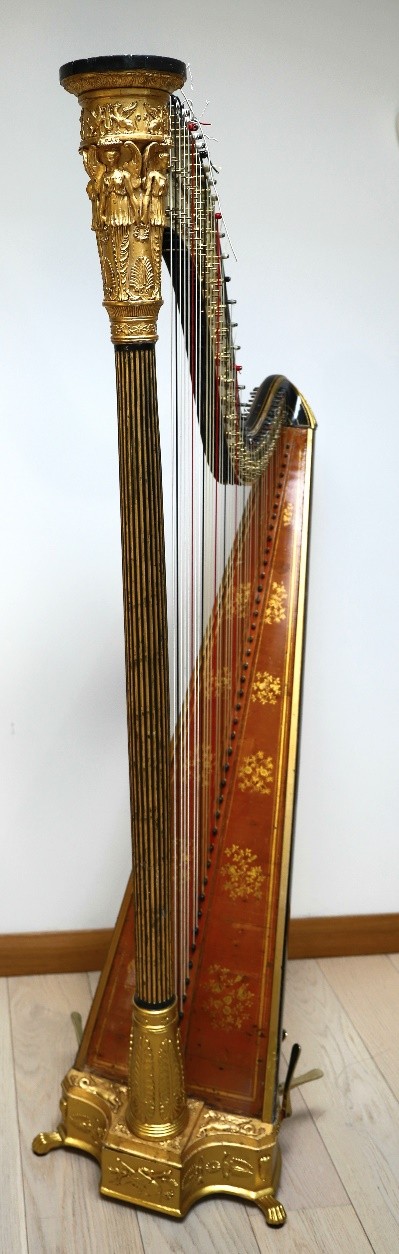

The mechanism was clogged with grease and oil so all of the metal moving parts were soaked in degreaser, cleaned, reassembled and re oiled. There was some worm damage on the pedal box, base of column and body, all of which has been repaired / replaced. The decoration and mouldings are all original but the original gilding has been painted over. It is now strung to concert pitch with Bow Brand low tension gut strings and silver wire wound on silk for the bass strings. Pilgrim has carried out the regulation.
This would make an ideal gigging instrument as the tuning pegs are silky smooth and the instrument has a rather more “robust” construction so will take the knocks and bumps of transportation well.
Stumpff (1769–1846) was a former employee of Sébastien Erard, as the piano maker James Shudi Broadwood (1772–1851) stated in a letter that Stumpff ‘long worked with Old Erard’
This would make an ideal gigging instrument as the tuning pegs are silky smooth and the instrument has a rather more “robust” construction so will take the knocks and bumps of transportation well.
Stumpff (1769–1846) was a former employee of Sébastien Erard, as the piano maker James Shudi Broadwood (1772–1851) stated in a letter that Stumpff ‘long worked with Old Erard’
Stumpff’s harps were based on the Erard Grecian design and according to James Shudi’s father John Broadwood (1732–1812) even surpassed those of Erard.
The main difference was that Erard used an external connection for the fourchettes, whereas Stumpff used an internal one, both producing essentially the same effect. Viennese piano maker Johann Baptist Streicher observed that Stumpff’s harps had a better, fuller tone than those of Erard, especially in the treble, which resulted from Stumpff’s construction of the harp soundboard with unequal thicknesses. Although Streicher may have been simply repeating Stumpff’s propaganda, his observation was similar to that of John Broadwood (1732–1812), the prominent London piano manufacturer. In 1803 Broadwood wrote to a customer who was interested in selling a piano and in buying a harp: “We will allow you 35 guineas for your Pianoforte in exchange for a new one with additional keys which we sell at 75 guineas … A Lady has a harp to sell made by Erat for which she asks 35 guineas. Erard is the most fashionable maker – but we know of no second hand instrument of his at present. Mr Stumpff, we think, makes the best Harp – his price is 75 guineas”.
This letter not only shows that a harp was as expensive as a grand pianoforte, but also provides a comparison by a contemporary author between three different harp makers working in London at that time: Erard, ‘the most fashionable maker’; Erat, a maker without any noteworthy attributes; and Stumpff, who, according to Broadwood, ‘makes the best Harp’.
The above notes taken from;
The Erard Grecian Harp in Regency England by Panagiotis Poulopoulos
The books is available in both print and Open Access form, which can be accessed and downloaded for free here: https://openaccess.boydellandbrewercms.com/?id=-259563